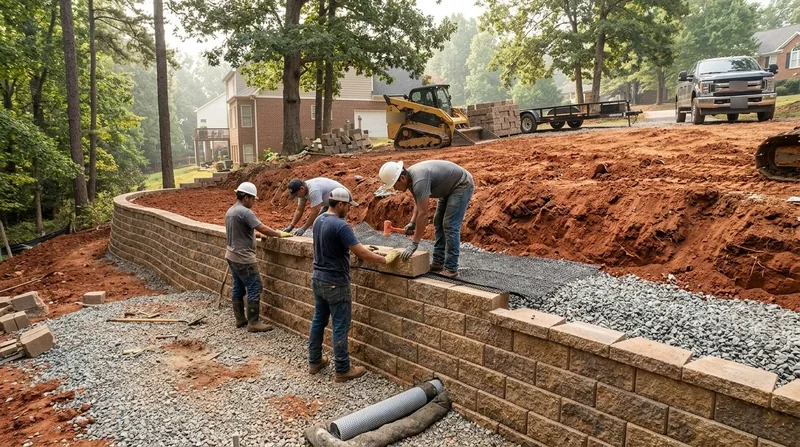




Greensboro sits on rolling uplands where dense red clay caps weathered granite and gneiss, and that clay is what drives every block wall decision here. Creek valleys like North Buffalo, South Buffalo, and Horsepen cut through the city, Lake Brandt and Lake Higgins hold the reservoirs, and the lots in between range from steep Lindley Park and Westerwood front yards to the tall cut-and-fill walls in newer Summerfield and Jamestown subdivisions. Block & segmental retaining walls in Greensboro work because mortarless engineered units flex with that clay instead of fighting it. We build Allan Block, Versa-Lok, and Keystone systems with geogrid reinforcement set at the depths the wall height and surcharge demand. Whether you are terracing a Sunset Hills backyard or replacing a rotting timber wall in Starmount, the block has to be right, the base has to be right, and the drainage has to be right. Start with our retaining wall installation page for the full scope of new builds.
Why Block Walls Matter on Greensboro's Red Clay and Creek Slopes
That red clay soaks up summer thunderstorms and tropical-storm rain, swells, then shrinks hard in winter freeze-thaw and summer drought. A wall with no drainage path collects hydrostatic pressure and starts to lean, and in Greensboro that is the failure mode we see most. Mortarless segmental block handles minor movement better than poured concrete or mortared stone because the units can shift, but only if the base is compacted and the geogrid is placed correctly.
- We set every wall on a compacted aggregate base dug below the frost-affected zone so clay movement does not lift the bottom course.
- We install geogrid in lifts tied to the block, which lets a tall wall in Summerfield or Jamestown hold back saturated clay without bulging.
- We backfill with free-draining stone and pipe water to daylight or a storm inlet, because Greensboro clay does not drain on its own.
- We cap and compact each course so the wall stays true through the shrink-swell cycle that follows every wet spring.
Every wall we build is designed around how the water leaves the hillside, not just how the block stacks.
Key info: A 1990s railroad tie wall in a Jamestown subdivision that has gone soft and tilted is the classic Greensboro replacement call. The tie rots, the clay behind it stays saturated, and the wall leans within a season. Segmental block with proper drainage fixes both problems at once.
Permits are set by the local building department, and thresholds vary. Greensboro and Guilford County generally require a permit for walls above roughly 4 feet measured from the footing, or any wall that supports a surcharge such as a driveway or structure, and tall or tiered walls may need engineered drawings. Verify the current rule with the City of Greensboro Planning Department before you dig.
How We Build a Segmental Block Wall in Greensboro, Step by Step
We start by reading the slope and the soil, not by picking a block color. On a Westerwood bungalow lot with a short steep front yard, the wall may only be three courses; on a newer cut-and-fill lot off Horsepen Creek Road it may run eight feet with two geogrid lifts. The sequence is the same either way, and it is what keeps the wall straight after the first wet winter.
- We locate utilities, confirm the property line and setback, and check whether the local building department requires a permit or engineered drawings.
- We excavate and compact a level aggregate base, then verify it with a plate compactor before the first block goes down.
- We set the base course dead level, then stack and check each course for batter and alignment as the wall rises.
- We install geogrid at the engineered intervals and embed it into compacted backfill so the wall acts as one reinforced mass.
- We place drainage stone, filter fabric, and perforated pipe, then outlet the water to daylight or a storm structure.
- We cap the wall, clean the site, and walk you through what to watch for during the first rainy season.
If the wall is part of a larger grading fix, we tie it into the slope stabilization and erosion control plan so water does not undercut the new work.
Key info: On a terraced backyard in Irving Park, we stepped three short block walls into the slope instead of building one tall wall. The terraces shed water at each level and kept the mature oaks' root zones intact, which a single 7-foot wall would have required us to cut through.
Block Wall Approaches We Use Across Greensboro
Not every slope wants the same system. We match the block, the reinforcement, and the drainage detail to the site, and we tell you when a different material is the better call. Here is how the main approaches compare.
| Approach | Description | Best for |
|---|---|---|
| Gravity segmental block | Mortarless Allan Block or Keystone units stacked with no grid, relying on mass and batter. | Garden walls and low terraces under about 3 feet. |
| Geogrid-reinforced SRW | Versa-Lok or Allan Block courses tied back with geogrid into compacted fill. | Tall walls, driveway surcharges, and cut-and-fill lots in Summerfield and Jamestown. |
| Tiered terraced walls | Two or three shorter walls stepped into the slope with planted benches between. | Steep yards in Lindley Park and Westerwood where a single tall wall would dominate. |
| Curved and freestanding block | Radius layouts and double-sided walls with cap units on both faces. | Driveway entrances, patios, and garden dividers. |
| Block over failed timber | We pull the rotting ties, rebuild the base, and set block in the same footprint. | 1980s and 1990s subdivisions with railroad tie walls that have gone soft. |
We will tell you when a poured concrete or natural stone wall fits the site better, but for most Greensboro backyards the engineered block system gives the best balance of cost, curve capability, and service life.
Block & Segmental Retaining Walls Cost in Greensboro: What to Expect
Most segmental block walls in Greensboro start around $25 per square foot of wall face, and that figure covers the block, base, geogrid, drainage stone, and pipe on a straightforward site. The number climbs when the wall is tall, when access is tight, or when the soil behind it needs extra reinforcement. A 3-foot garden wall in Starmount and an 8-foot reinforced wall on a Horsepen Creek slope are not the same job, even if the square footage looks similar.
The biggest cost drivers we see are wall height and surcharge (a driveway or structure behind the wall adds engineering), excavation and haul-off of heavy red clay, access for a mini-excavator, and whether the old wall has to come out first. A rotting railroad tie wall adds demolition and disposal. Engineered drawings, if the building department requires them, add a design fee. Getting two or three estimates is smart because the scope of drainage and base prep varies widely between contractors, and the cheapest bid often skips the geogrid or the drain pipe. Our full pricing overview breaks down how each factor moves the number.
Block & Segmental Retaining Walls Near Me: How to Hire in Greensboro
When you search for block and segmental retaining walls near me in Greensboro, you get a long list of names, and most of them can stack block. The difference shows up two winters later when the wall is still straight and the yard is dry. Ask for proof of license and insurance before anyone walks your slope, and get at least two other estimates so you can compare what each bid actually includes.
Ask for local references on walls at least two years old, and ask specifically whether the wall has drainage pipe and geogrid. Confirm who pulls the permit if the wall is over the threshold, and check any HOA architectural review rules before you pick a block color or cap. If your property has protected trees or sits near a creek buffer, confirm the setback rules with the city before excavation. Reach out through our contact page to schedule a free on-site estimate.
Block & Segmental Retaining Walls in Greensboro: Pricing Guide
| Service | Price | Details |
|---|---|---|
| Low garden wall (under 3 ft) | Starting at $25/sq ft | Includes block, compacted base, cap, and basic drainage stone on an accessible site. |
| Geogrid-reinforced wall (3 to 6 ft) | Starting at $38/sq ft | Adds geogrid lifts, drainage pipe, and filter fabric for saturated Greensboro clay. |
| Tall or surcharge wall (6 ft and up) | On estimate | Height, driveway surcharge, and possible engineered drawings require an on-site look. |
| Railroad tie or timber replacement | On estimate | Includes demolition, haul-off of rotting ties, and a new base in the same footprint. |
| Travel | Included | In Greensboro and surrounding areas, no separate call-out or mileage fee. |
| Estimate | Free | Response within 24h at (336) 203-7877, no obligation to book. |
Indicative pricing, the exact cost depends on square footage, finish, and site access. Free personalized estimate within 24h at (336) 203-7877.


