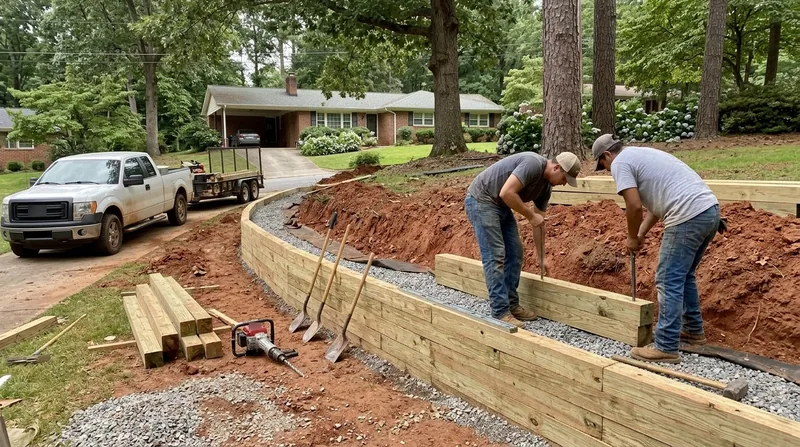




Timber Retaining Walls in Greensboro
Greensboro sits on rolling Triad uplands where dense red clay lies over weathered granite and gneiss saprolite, and every timber wall we build has to work with that ground, not against it. From the short steep front yards of Lindley Park and Westerwood bungalows to the 1980s and 1990s subdivisions out toward Summerfield and Jamestown, pressure-treated timber walls still hold garden beds and low terraces across this city. They are the budget-friendly choice, and in the right spot they perform well for years. But humid clay ground is hard on wood, and we tell homeowners straight when timber makes sense and when a longer-lasting material is the better call. If you are comparing options, start with our retaining wall installation page for the full picture.
Why Timber Walls Fail Fast in Greensboro Clay
Our clay is the whole story. It soaks up summer thunderstorms and tropical-storm rain, swells against the back of a wall, then shrinks in winter freeze-thaw and summer drought. Timber walls that lack proper drainage and gravel backfill rot from the inside out and start to lean within a decade. The failure mode that dominates here is saturated clay pushing a wall that was never built to shed water.
- We see untreated or under-drained timber beds bulging along Horsepen Creek and North Buffalo Creek lots after a wet spring.
- Railroad tie walls from the 1980s subdivisions near Jamestown and Summerfield are now creosote-soaked and failing.
- Low garden walls in Irving Park and Sunset Hills often sit against old brick and fieldstone that needs careful handling.
- Timber set directly on clay without a gravel footing settles and racks out of level within a few seasons.
If your wall is already leaning or bowing, that is a repair conversation, not a new-build one, and it moves to the front of the line.
Key info: A timber wall in Greensboro clay needs a gravel footing, free-draining backfill, and a perforated drain pipe at the base. Skip any of those three and you are rebuilding in 8 to 12 years.
For permit thresholds and setback rules, check with the City of Greensboro building department before you dig. Walls above roughly 4 feet, or walls that support a driveway or structure, often need a permit and sometimes engineered drawings. Greensboro Planning Department is the place to verify the current rules for your lot.
How We Build a Timber Wall That Lasts in Greensboro
We do not just stack lumber on dirt. Every timber wall we build starts with the drainage and footing that our clay demands, and we size the wall to the load it actually carries. Here is the sequence we follow on a typical Greensboro job.
- We walk the slope and check soil, water flow, and any old wall we are replacing.
- We excavate to a stable base and set a compacted gravel footing below the frost line.
- We lay pressure-treated timbers with proper overlap and fasten them with galvanized spikes or structural screws.
- We install perforated drain pipe and gravel backfill behind every course.
- We backfill with free-draining material and compact in lifts, never in one dump.
- We cap the wall and grade the soil so surface water runs away, not into the wall.
On a sloped Lindley Park front yard, that often means a short tiered wall instead of one tall face, which keeps the load down and the permit question simple.
Key info: A homeowner near Lake Brandt had a 3-foot timber bed that had rotted through after 11 years because it was set on bare clay with no drain. We rebuilt it on gravel with a drain line and proper backfill, and it is now in its fifth season without movement.
If you are weighing timber against a longer-lived option, our block and segmental retaining walls page covers the alternative for taller or load-bearing walls.
Timber Wall Approaches We Use in Greensboro
Not every timber wall is the same job. The right approach depends on height, load, and how wet the ground stays. Here is how we match the method to the site.
| Approach | Description | Best for |
|---|---|---|
| Low garden bed wall | Pressure-treated timbers stacked 2 to 3 courses high on a gravel footing. | Flower beds and short terracing in Lindley Park and Westerwood yards. |
| Tiered terrace wall | Two or three short walls stepped up a slope, each with its own drain. | Steep front yards and sloped lots where one tall wall would be risky. |
| Timber wall with drainage retrofit | Rebuild of an existing timber wall with gravel backfill and drain pipe added. | Older timber walls that are still sound but sitting in wet clay. |
| Timber to block replacement | Removal of failed timber and rebuild in segmental block where load is high. | Walls over 4 feet or walls carrying a driveway or structure. |
We tell you which row your project falls into before you commit to a material.
Timber Retaining Walls Cost in Greensboro: What to Expect
Most timber wall work in Greensboro starts from $20 per square foot, and that figure covers a properly built wall with gravel footing, drainage, and backfill. The number moves up with height, access, and how much old material we have to haul out. A low bed in a Summerfield backyard is a different job from a tiered wall on a steep Lindley Park slope.
Factors that change the price include wall height and length, how tight the access is for equipment and material, whether we are removing an old railroad tie or timber wall, and how close the wall sits to a house, driveway, or mature loblolly pine roots. Wet clay and poor drainage also add labor, because we have to fix the water problem, not just the wall.
Get two or three estimates and compare what is actually included. A low bid that skips the drain pipe or gravel backfill is not a bargain in this clay. Our full pricing overview breaks down the ranges in more detail.
Hiring a Timber Retaining Wall Contractor Near Me in Greensboro
Timber wall work looks simple until it fails, so hire like the drainage matters, because it does. Ask for proof of license and insurance, get at least two or three written estimates, and check references from jobs in Greensboro clay, not just photos of finished walls.
- Confirm the contractor is fully insured and ask for a certificate before work starts.
- Ask whether the estimate includes gravel footing, drain pipe, and backfill, or just the timbers.
- Check references for walls built at least three years ago so you can see how they held up.
- Ask who pulls the permit if your wall is above the local threshold or supports a driveway.
- Check any HOA rules for wall height, material, and setback before you sign.
If a contractor cannot explain how they will handle water behind the wall, keep looking.
Ready for a straight answer on your wall? Contact us for a free estimate and we will tell you whether timber is the right call for your site.
Timber Retaining Walls in Greensboro: Pricing Guide
| Service | Price | Details |
|---|---|---|
| Low timber garden wall | Starting at $20/sq ft | Includes gravel footing, pressure-treated timbers, drainage, and backfill for beds up to 3 feet high. |
| Tiered or taller timber wall | Starting at $28/sq ft | Adds stepped courses, extra drainage runs, and more labor for walls 3 to 4 feet high. |
| Timber wall removal and rebuild | Starting at $32/sq ft | Covers hauling out old railroad ties or rotted timber plus a full drainage rebuild. |
| Complex or large-scale job | On estimate | Steep slopes, tight access, or walls near structures need an on-site look before pricing. |
| Travel | Included | In Greensboro and surrounding areas, no separate call-out or mileage fee. |
| Estimate | Free | Response within 24h at (336) 203-7877, no obligation to book. |
Indicative pricing, the exact cost depends on square footage, finish, and site access. Free personalized estimate within 24h at (336) 203-7877.


