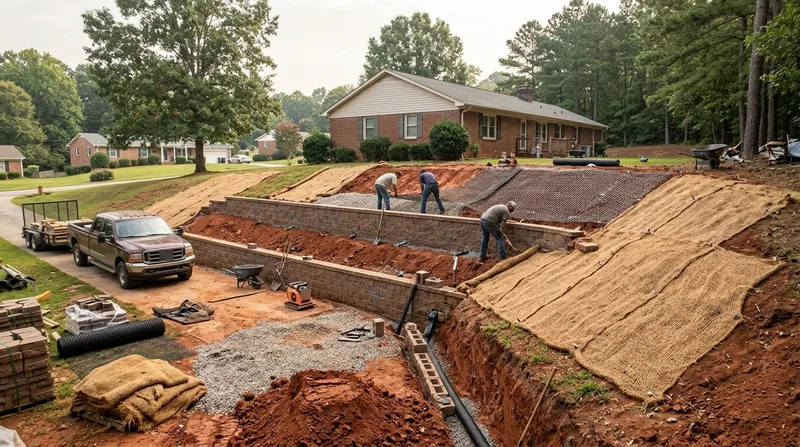




Greensboro sits on rolling uplands where dense red clay covers weathered granite and gneiss saprolite, and that clay is what makes Slope Stabilization & Erosion Control in Greensboro a real structural issue rather than a cosmetic one. Creek valleys like North and South Buffalo Creek and Horsepen Creek cut through the city, the reservoirs at Lake Brandt and Lake Higgins sit in the same watershed, and neighborhoods from Lindley Park and Westerwood bungalows to the 1980s and 1990s subdivisions toward Summerfield and Jamestown all fight the same problem: clay that soaks up summer storms and tropical rain, then shrinks in drought and heaves in winter freeze-thaw. When a front yard in Irving Park or Sunset Hills starts sliding, or a cut-and-fill grade behind a newer segmental block wall in Summerfield gives way, the fix has to address water and soil, not just the surface. We build terraced walls, geogrid reinforcement and drainage systems that hold the grade where it belongs. If the slope is already moving, start with leaning and collapsed wall repair before the damage reaches the footing.
Why Greensboro Slopes Fail and What Stabilization Actually Fixes
The dominant failure mode here is saturated clay losing shear strength after a heavy summer storm or a tropical system dumps several inches in a day, then the same clay shrinking and cracking through winter freeze-thaw and dry spells. Add the tall loblolly pines and oaks common across the city, whose roots lift and channel water, and you get the classic Greensboro pattern: a wall that leans, a driveway that cracks, or a creek bank that slumps a few feet each season.
- We identify where water is entering the slope, because most failures in Greensboro start with poor surface drainage rather than the wall itself.
- We check the existing wall for footing movement, bulging and missing weep points before recommending any repair.
- We evaluate soil type and depth, since red clay over saprolite behaves very differently from fill placed during grading.
- We look at surcharge loads, including driveways, pools and structures sitting above the wall, which the local building department treats as a permitting trigger.
- We document the slope and the drainage path so the fix matches the actual failure, not a guess.
Once we know why the slope is moving, the stabilization plan follows directly from the soil and water conditions on your lot.
Key info: A homeowner in Lindley Park had a short, steep front yard where the clay had slid against a 60-year-old fieldstone wall after a July storm. The wall itself was sound; the missing piece was drainage behind it. Regrading the surface flow and adding a proper drain behind the wall stopped the movement without replacing the stone.
Permits matter here. Many jurisdictions require a permit for walls above roughly 4 feet measured from the footing, or when the wall supports a driveway or structure, and engineered drawings may be required for tall or tiered walls. Always verify thresholds with the City of Greensboro building department before work starts: Greensboro Planning and Building.
How We Stabilize a Greensboro Slope, Step by Step
We treat slope stabilization as a water-management job first and a wall-building job second. On the rolling uplands around Greensboro, a terraced wall with geogrid reinforcement only performs if the clay behind it drains, so we design the drainage and the structure together. Every job starts with a site walk and a written scope.
- We walk the slope and mark the failure zone, including any cracking in the driveway, patio or wall face.
- We test and observe the soil profile to confirm how deep the clay sits over saprolite and where the water table shows up.
- We design the terrace layout, wall height and geogrid spacing to match the load and the setback rules.
- We install drainage, including surface grading, footing drains and weep points, before backfilling.
- We build the wall or reinforcement in lifts, compacting backfill as we go.
- We restore the surface with erosion control, seed or stone, and walk the finished grade with you.
The result is a slope that sheds water the way it should and a wall that carries the load it was designed for.
Key info: A 1980s subdivision lot in Jamestown had a rotting railroad tie wall holding a terraced backyard. The ties had failed and the clay was creeping downhill toward the patio. We replaced the tie structure with a geogrid-reinforced segmental block wall and a drain behind the footing; see our railroad tie wall replacement work for that scope.
Stabilization and Erosion Control Methods We Use Around Greensboro
Not every slope needs the same approach. The right method depends on height, soil, water volume and what sits above and below the slope. Here is how we match the method to the site.
| Approach | Description | Best for |
|---|---|---|
| Terraced retaining walls | Two or more shorter walls stepping up the slope, each with its own drainage. | Steep residential yards in Lindley Park and Westerwood where a single tall wall is impractical. |
| Geogrid reinforcement | Grid layers tied into compacted backfill to resist clay movement. | Taller segmental walls and cut-and-fill grades in newer Summerfield subdivisions. |
| Surface drainage and regrading | Swales, berms and downspout routing that move water off the slope. | Slopes where the wall is sound but water is the real problem. |
| Footing drains and weep points | Perforated pipe and gravel behind the wall to relieve hydrostatic pressure. | Any wall holding saturated red clay through Greensboro's storm season. |
| Erosion control blankets and vegetation | Temporary and permanent cover to hold bare soil until roots establish. | Creek banks near Horsepen Creek and freshly graded slopes. |
We match the method to the site conditions, and we tell you plainly when a simpler, cheaper fix will hold.
Slope Stabilization & Erosion Control Cost in Greensboro: What to Expect
Every job starts with a free estimate, because slope work is priced from the site, not from a menu. A small regrade and drainage correction on a bungalow lot in Westerwood is a modest project; a tall geogrid-reinforced wall holding a driveway in Summerfield or a creek-bank repair near Lake Brandt runs much higher because of excavation volume, reinforcement and engineering. We give you a written scope with line items so you can compare bids fairly.
Cost moves with slope height and length, how much clay has to be excavated, whether geogrid or engineered drawings are required, access for equipment, and how close the work sits to the house, driveway or property line. Getting two or three estimates is smart on any stabilization job: it keeps pricing honest and shows you which contractors actually walked the slope. Our full pricing overview breaks down the ranges in more detail.
Hiring a Slope Stabilization Contractor Near Me in Greensboro: What to Check
Slope work is unforgiving of shortcuts, so vet the contractor before you sign. A crew that skips drainage or geogrid will hand you a wall that leans within a few seasons, and the repair costs more than the original job. Use these checks on every bid you collect.
- Confirm the contractor is fully insured, and ask for a certificate of insurance before work begins.
- Get at least two or three written estimates with itemized scope, not a single lump-sum number.
- Ask for local references on slopes similar to yours, and call them.
- Ask who pulls the permit and whether the plan meets City of Greensboro setback and property-line rules.
- Check HOA requirements before excavation, since many Greensboro subdivisions restrict wall height and materials.
If a bid looks too cheap for the scope, it usually is. Reach out through our contact page and we will walk your slope and give you a straight answer.
Slope Stabilization & Erosion Control in Greensboro: Pricing Guide
| Service | Price | Details |
|---|---|---|
| Drainage correction and regrading | Free estimate | Includes site walk and written scope; price moves with slope length and excavation volume. |
| Terraced wall stabilization | Starting at $4,500 | Covers wall build and drainage; height, geogrid requirement and access drive the final number. |
| Geogrid-reinforced tall wall | Starting at $9,000 | Includes reinforcement and footing drain; engineered drawings and surcharge loads raise the scope. |
| Creek bank and severe erosion repair | On estimate | Needs an on-site look at soil depth, water flow and access before any number is given. |
| Travel | Included | in Greensboro and surrounding areas, no separate call-out or mileage fee. |
| Estimate | Free | Response within 24h at (336) 203-7877, no obligation to book. |
Indicative pricing, the exact cost depends on square footage, finish, and site access. Free personalized estimate within 24h at (336) 203-7877.


