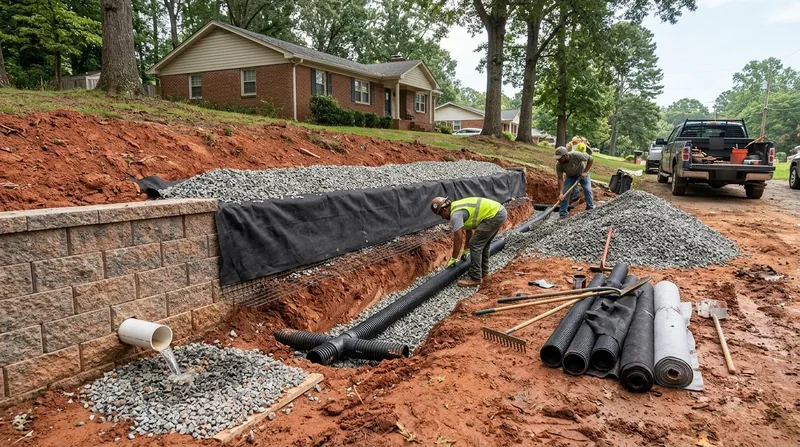




Retaining Wall Drainage in Greensboro: Stop Clay Soil From Pushing Your Wall Over
If you own a wall in Greensboro, the biggest threat is not the block or the stone, it is the water trapped behind it. Retaining Wall Drainage in Greensboro is the work that keeps hydrostatic pressure from building up in our dense red clay and shoving the wall forward. Greensboro sits on rolling uplands where clay sits over weathered granite and gneiss saprolite, and that clay holds water like a sponge after a summer storm. From the old fieldstone walls in Irving Park to the tall segmental block walls in Summerfield, every wall here needs a path for water to escape. Without one, your wall leans, cracks, and eventually fails. We design and install drainage systems that relieve that pressure and add years to the wall. For walls that are already moving, see our leaning and collapsed wall repair service before the damage spreads.
Why Drainage Is the Difference Between a Wall That Lasts and One That Leans in Greensboro
Greensboro's clay is the whole story. When tropical-storm rain or a heavy summer thunderstorm soaks the ground, that clay swells and pushes against the back of the wall. Then winter freeze-thaw cycles and summer drought shrink it again, and the cycle repeats. The wall that survives is the one with gravel backfill, weep holes, and a French drain at the footing. The wall that fails is the one somebody backfilled with the same clay they dug out.
- Hydrostatic pressure from saturated clay is the number one cause of retaining wall failure in Greensboro.
- Weep holes alone clog with fines and stop working within a few seasons if they are not backed by gravel.
- Walls built on North and South Buffalo Creek and Horsepen Creek slopes see concentrated runoff that a bare wall cannot handle.
- Old fieldstone and brick garden walls in Sunset Hills and Irving Park often have no drainage at all and need retrofits.
- Timber and railroad tie walls in 1980s and 1990s subdivisions toward Jamestown rot faster when water sits against them.
If your wall shows any of these warning signs, drainage work now costs far less than a full replacement later. The City of Greensboro's building permit office can confirm whether your wall project needs a permit before work starts.
Key info: A homeowner in Lindley Park had a 3-foot brick garden wall that bulged after every heavy rain. The wall had no weep holes and was backfilled with clay. We cut in weep holes, replaced the clay backfill with washed gravel, and added a footing drain. The wall has not moved since.
How We Fix Retaining Wall Drainage in Greensboro, Step by Step
We start by finding out where the water is coming from and where it is going. On most Greensboro lots, that means looking at the slope above the wall, the downspouts, and the grade on the street side. Then we open up the wall, fix the backfill, and give the water a clear exit. We do not just drill a few holes and call it done.
- We inspect the wall face, the footing, and the soil behind it to find the pressure source.
- We excavate behind the wall and remove saturated clay backfill down to the footing.
- We install a perforated French drain in washed gravel at the base of the wall.
- We set weep holes at the correct spacing and height so water can exit the face.
- We backfill with clean gravel and filter fabric so fines cannot clog the drain.
- We waterproof the wall face where the wall type calls for it.
- We restore the grade and test the system with a hose before we leave.
On a recent job off Horsepen Creek Road, a tall segmental block wall was leaning about 2 inches at the top after two wet summers. We rebuilt the drainage behind the wall and added a surface swale to divert runoff from the hillside above. The wall has stayed plumb through two more hurricane seasons.
Key info: If your wall sits near a creek valley or on a slope in Westerwood or Starmount, surface water from uphill properties can overwhelm a wall that has good drainage but no diversion. We look at the whole lot, not just the wall. For walls in the 27405 ZIP, see our local drainage page.
Drainage Approaches We Use on Greensboro Walls
Not every wall needs the same system. A low garden wall in Fisher Park needs weep holes and gravel. A tall block wall holding a driveway in Summerfield needs a footing drain and engineered backfill. We match the approach to the wall, the soil, and the water load.
| Approach | Description | Best for |
|---|---|---|
| Weep holes with gravel backfill | Openings at the base of the wall backed by washed gravel and filter fabric | Low garden and landscape walls under 3 feet |
| Footing French drain | Perforated pipe in gravel at the base, daylighted downhill | Tall segmental block and concrete walls |
| Wall face waterproofing | Membrane or coating on the back of the wall to keep water out of the block | Concrete and block walls in wet clay |
| Surface diversion swale | Graded channel above the wall that carries runoff away from the structure | Walls on slopes and near creek valleys |
| Retrofit drainage on old walls | Cutting in weep holes and replacing clay backfill on existing walls | Aging fieldstone, brick, and timber walls |
Every system we install is tested before we leave the site, and we explain how to check it after a heavy rain.
Retaining Wall Drainage Cost in Greensboro: What to Expect
Drainage work starts at From $2,500 for a straightforward retrofit on a low wall, and goes up from there. The biggest cost drivers are wall height, the length of drain run, how much saturated clay has to be excavated, and access for equipment. A wall in a tight backyard in Westerwood costs more to work on than an open lot in Summerfield, because everything has to be moved by hand.
We recommend getting two or three estimates for any drainage job. Ask each contractor what they plan to do with the clay backfill, how they will daylight the drain, and whether the price includes restoring the grade. A cheap quote that leaves the clay in place is not a drainage job. You can see our full range of drainage and wall services on the pricing page.
What to Look for When Hiring a Retaining Wall Contractor Near Greensboro
Drainage work is invisible once it is buried, so the contractor's experience matters more than the price. Ask for proof of license and insurance, and call the references they give you. Ask whether they pull permits when the wall height or surcharge requires it, and check with the local building department on thresholds. If you live in an HOA neighborhood, confirm the rules before any work starts.
If you want a straight answer on what your wall needs, contact us for a free estimate. We will tell you what we see and what it will cost, with no pressure to book.
Retaining Wall Drainage in Greensboro: Pricing Guide
| Service | Price | Details |
|---|---|---|
| Weep hole and gravel retrofit | Starting at $2,500 | Includes cutting weep holes, replacing clay backfill with washed gravel, and filter fabric on low walls |
| Footing French drain installation | Starting at $3,800 | Perforated pipe in gravel at the base, daylighted downhill, priced by wall length and access |
| Full drainage rebuild with waterproofing | Starting at $6,500 | Excavation, new drain, wall face waterproofing, and grade restoration on tall or tiered walls |
| Complex or large-scale job | On estimate | Tiered walls, creek-side slopes, and tight access need an on-site look before we quote |
| Travel | Included | in Greensboro and surrounding areas, no separate call-out or mileage fee |
| Estimate | Free | Response within 24h at (336) 203-7877, no obligation to book |
Indicative pricing, the exact cost depends on square footage, finish, and site access. Free personalized estimate within 24h at (336) 203-7877.


